It would be hard to live in Seville even though it is one of Europe’s most beautiful cities. It is hot, the streets are wide and even though tree-lined and full of parks and plazas it is still hot. Walking around being a tourist during the heat of the day must be very amusing for the locals as everything except the cafes are shut. All the sane Sevillians are having a Siesta in air- conditioned comfort, or at the very least under a tree.
Metropole parasol
completed 2011
leg of pork?
Apparently, any Flamenco dance exhibition that includes a meal is a tourist trap. Asking around we discovered a hole in the wall type place where the drinks were cheap, the food was served kiosk style on paper plates and the seating – wooden benches and tables. The show started at 10pm and involved 3 people: the female dancer, the male singer and the male guitarist. The male starts with a horrendous howl that seems standard in flamenco. The dirge is dramatic and the dancer, moved by his song, stands up to give the most amazing, passionate performance. This is the raw flamenco that would have been found in the taverns of the past. Her angst was channeled through the dance and you wouldn’t want to cross her as her face contorted into something quite grotesque as the dance continued. It was so skillful and passionate with its feet and clapping patterns.
Filled with enthusiam for the dance, visited the Flamenco Museum. 10 Euros for the only flamenco museum in Europe! It had not been updated since the 1970’s and the film clips proved it. What was interesting, was, a famous Flamenco dancer said that you don’t have to understand the story if the dance moves you. Very true.
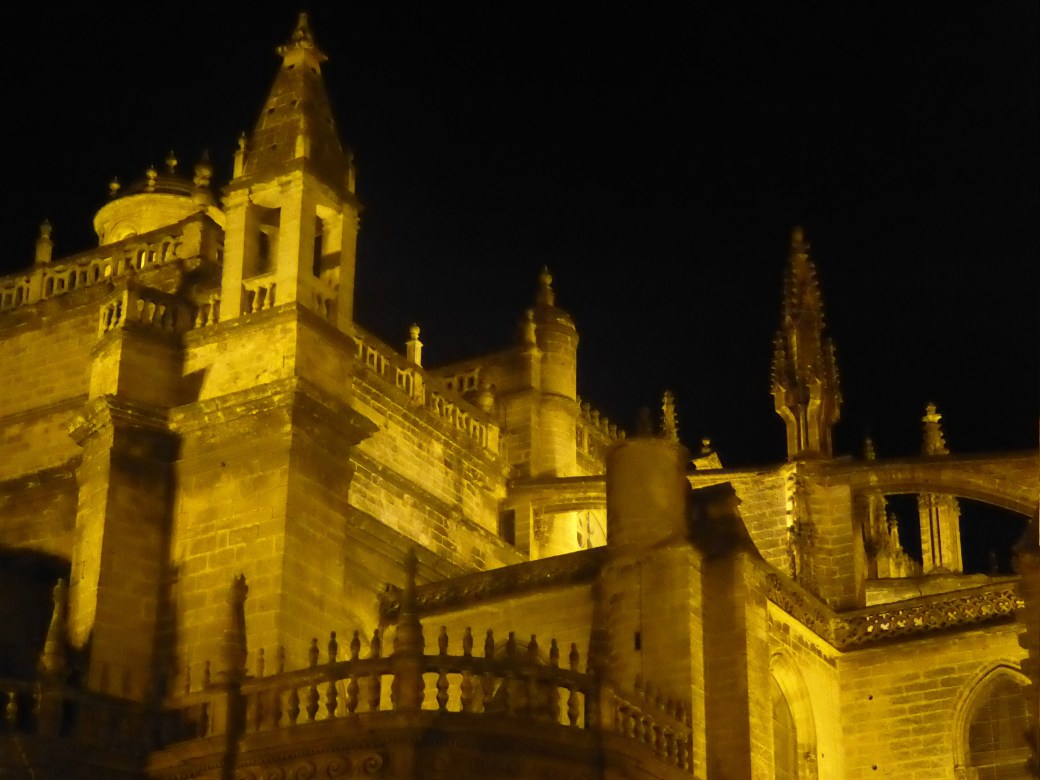
A walking tour around the city showed us the Catedral y Giralda with its history showcased via its transitional architecture from Islam to Christianity.
The Real Alcazar, magnificent spot in the middle of the city that housed the palaces over the centuries and the wonderful gardens.
The Plaza Espana. This is an interesting tale. These buildings were built for a 1929 world exhibition to showcase Spain in all its glory. This ambitious idea was to release Spain from its financial doldrums by showing the world how wonderful and innovative Spain was. No one came! The timing couldn’t have been worse for the Spanish as the Great depression kicked in at the same time. It was a disaster. The buildings went to rack and ruin until 50 years later when it was all renovated. Now each of the beautiful buildings are utilised. At first sight, it would appear you were in Las Vegas except these buildings are real and the area is magnificent.
Again, our walking tour guide, gave us advice regarding great, cheap places to eat and it was Tapas again. Dos de Mayo. 2nd of May, a very special day. It was a bit away from the tourist area in Plaza de la Gadivia. Scrumptious food, sangria and a bill of 18 Euros.
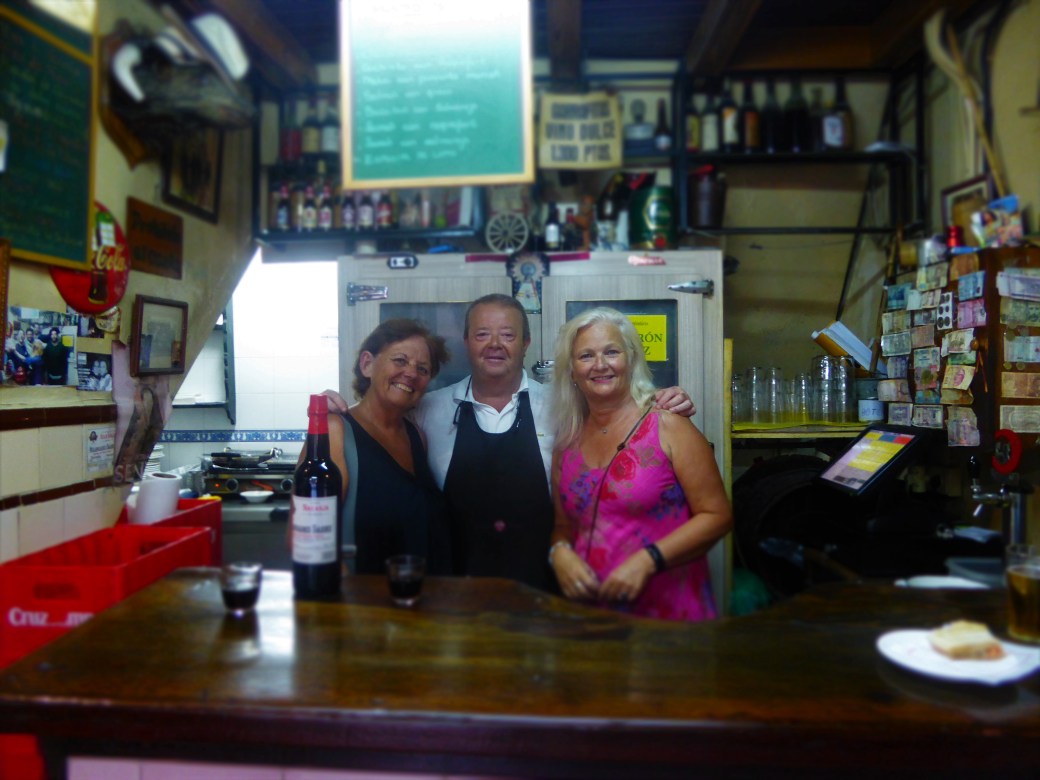
There is also an iconic old store that sells Orange Wine. It is like sherry and famous in Seville.
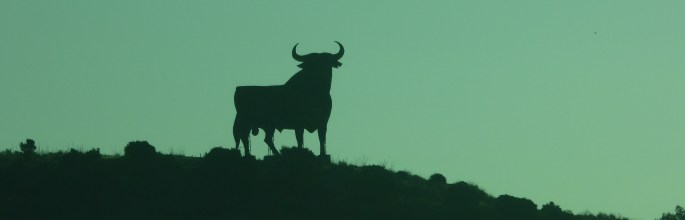
Bullfighting. What do we think of bullfighting? It is embedded in the Spanish culture along with the Flamenco. Is it man against beast or bloody torture for a helpless animal that ends up with his head stuffed and put up on a pillar in a restaurant? What still determines this culture? Souvenir shops sell bulls with smiling faces and posters promoting the heroic act of the matadors.
The food markets are wonderful and the Mercado d Triana is a great example of tradition. The stall holders don’t just have a number but instead their names are spelt out in the classic tiles above their stand.
Cadiz
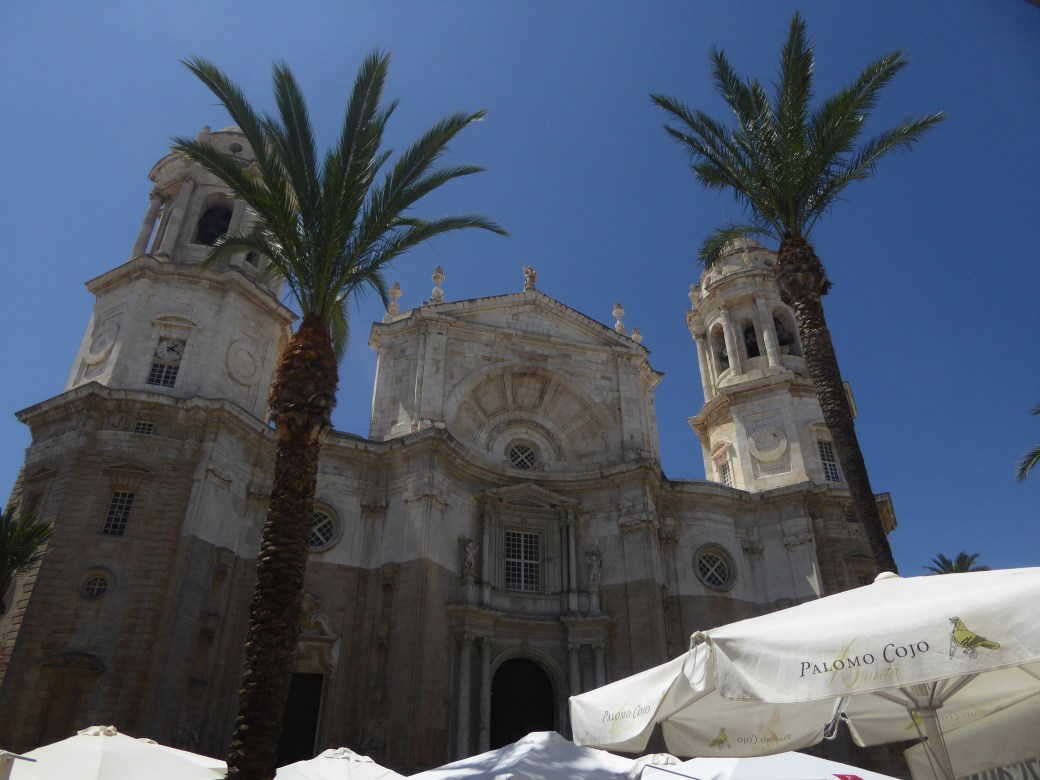
An hour and a half by bus to Cadiz and a return trip costs 23 Euros. A fun day and out of the dry heat of Seville. Cadiz is a port town and is very old. There was a market in the square where the artisans were only allowed to sell hand-made work. It was a nice change from all the African stuff that is flooding into the south of Europe. Why would you want a souvenir elephant from Spain?
The beaches here are very similar to Australian beaches like Manly or Surfers. The only difference being a bloody big Cathedral at one end. The Atlantic Ocean was warm, the sand was white and the waves were perfect.
Travelling by bus is a lot cheaper than train. The 6 1/2 hour bus ride from Seville to Madrid was 22 Euros It takes a bit longer but the train is almost 3 times the price.
Spain is olive trees and it looks like planting is on the increase as there are hectares of young trees in the fields. Did you know there are specific olives for wine and beer? A specific type for every occasion!
Seville was hot but Madrid feels hotter, partially because it is not on a large river and the boulevards and squares have no cover. It is difficult to walk around in the intense dry heat but with perseverance embarked on another “free” walking tour. His name was Will and he was a Pom. Immediate thought was, “ Is this his Summer job? He was extremely knowledgeable and passionate about Madrids political and social history. Another great walking tour, this time with OGO tours.
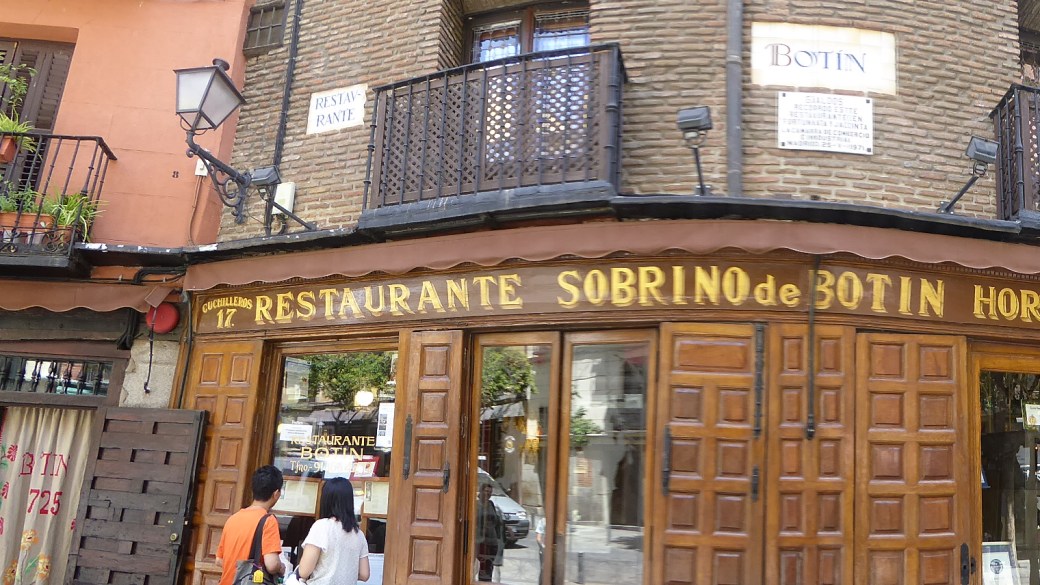
Madrid has the oldest restaurant in the World (1725), old meaning continuous use. Restaurante Sobrino de Botin, it is in the Guinness book of records and has a menu signed by Charles Dickens and was Ernest Hemingways favourite spot. Impressed!
There is a place called Museo del Jamon which means ham museum. You can buy a beer for .90 Euro cents and get a little plate of different ham and salami for free. Historically, tapas was always free. Its translation means “lid” as drinkers used to put bread over the beer to stop dirt, flies or bugs getting into their drink. Another story is that the king was fed up with having drunk workers so he insisted that the taverns serve food with the drink for free to line the workers stomachs.
Jamn, Jamon and more Jamon
It is quite a treat to get olives and nuts or meat when you order a beer. Makes you feel special.
The coat of arms for Madrid is a bear and a Madrona tree. There is a lovely liquor called, funnily enough, Licor Madrono. It is made from the berries of this tree and served in chocolate cups. The older people drink this after dinner as a digestive for good health and, apparently it works as Spain has one of the highest life spans. It must work because the bread, fried food, fatty meats and huge number of smokers should kill off any other race.
Well the last full day in Madrid was eventful. The morning and into the afternoon at the Theissen Museum. This place is equal to MOMA in New York for its Gauguin, Cezanne, Van Gogh, Munch etc. .A wonderful place.
Next to another Museo del Jamon for another .90Euro beer and free tapas. The ham here is the best in the world or maybe just the best we have ever tasted.
Then, sighted a beautiful facade of a restaurant, took a photo of it with a lady smoking a cigarette outside. It looked intriguing. She told us it had delicious food so we booked our tickets to Carmen and went back there for magnificent garlic prawns that was a dish shared. The manager of Fatigas del Querer, Pepe was a red headed Spaniard and was delightful.
Carmen the ballet and flamenco at the Teatro Apolo was a highlight of our trip to Madrid.
We have had an awesome time in Spain. From the Camino de Santiago in Galicia to Barcelona with its Gaudi and the mountains of Montserrat. To Malaga and its beaches, beautiful Seville, the port of Cadiz and artistic Madrid. Spain has been extremely good to us and will be missed and remembered fondly.
From Barcelona airport to accommodation in Corbera de Lobregat, Catalonia. The hotel Can Fisa is set high up in the mountains where the roads equal the coastline of Amalfi. Classed as Barcelona, it was 17 kilometres and 1 hour outside the main city.
It is always a surprise to see front doors opening onto the narrow streets. A lack of concentration could have you walking out the front door and into a bus as the buses almost touch both sides of the road.
Breathe in!
Our room at Can Fisa hotel overlooked the mountains and the small villages tucked into each valley. In the evening, there was a sound of drums and the occasional gunfire that echoed around the mountains reverberating and growing louder until all was quiet at 5am. It was a village festival that is celebrated for 2 weekends in July but no one could tell us why.
View from our room
A welcome addition
Night life
The restaurant at the hotel was excellent but a bit out of our budget. The few nights we ate there, we were given a little morsel of tapas to try gratis. The Chef here did a great job.
The free, guided, Gaudi tour in Barcelona was great and well worth the 10 Euros per person that is a donation after the 21/2 hours. Our guide, Miguel was very knowledgeable regarding all things Gaudi.
Building before Gaudi
Building after Gaudi
Close up of facade
Here are few fun facts: Gaudi’s first commission was for streetlamps in Barcelona however he argued his payment and was crossed off the list of available architects by the council and never worked for them again.
The Culprit x 4
Casa Batlo
La Pedrera Las Casa Mila
His work came from rich family commissions who he nearly sent broke paying for his perfectionism. He never explained his work and has left a lot of questions unanswered including: why do his chimneys look like ice-cream cones? He used only the best materials in his buildings so the outside of Casa Batlo was covered in Murano glass. Gaudi dressed as a poor man and his life ended when he was hit by a tram, while going to confess his sins at the age of 74. Because he looked like a pauper, he was taken to the poor hospital. Eventually, when he was recognised, he refused to be moved and died 2 days later.
All the statues in The Sagrada Familia were made from plaster casts of real people, even a donkey was cast after being put to sleep first (Gaudi was an animal lover). You don’t want to know how he made the lifelike babies in the Roman Centurion scene. The Sagrada Familia (the cathedral for the poor) is still a work in progress and it is said that if the huge spire, yet to be built, stays up it will be the third miracle and Gaudi will be classed as a Saint and the Basilica will become a Cathedral!
The “you don’t want to know” scene
the star wars scene
The background scene
The real front of Sagrada Familia Scene
cranes, cranes and cranes
Another positive regarding a walking tour is that if the guides are good, they tell you about other things, like where to eat and what to do. Miguel told us about Carrier de Blai. A street full of Pinxos bars or Pinchos in English. They are fantastic little tapas on bread stuck together with a toothpick. All 1 Euro each with a big glass of beer at 2 Euros. Fantastic food. Four will do you for lunch.
i know ! but it was a very hot day
lots of pinxos
Monserrat is a breathtakingly beautiful Benedictine monk, mountain retreat. It was Sunday so we experienced mass in the Basilica. The trip to Montserrat was by bus and train and then a smaller train travels up the side of the very steep mountain. So, the choir…. the choir is very well known and the Monastery choir boys have made over 100 recordings. So excited to see these young boys in their choir clothes and their beautiful voices ringing through the acoustically perfect Basilica.
ontserrat
The Basilica
light a candle
The Cross of Sant Miquel
The boys were on holidays! Replaced by a small group of female choristers from Italy. No uniform, all higgledy piggledy in their attire. The younger girls looked like they didn’t want to be there. As disappointing as scaffolding!
Oh well, walked to the Mirador de Sant Migual for a panoramic view and caught the cable car down to the train.
The Cable Car
A long way up
The Ramblas in Barcelona City, has changed a lot in 30 years. It is quite sophisticated now and is a pleasant walk to the harbour via the Boqueria market.
Another guided tour around the older areas included the Gothic sector and the Jewish area. These tours are so worthwhile as you learn so many interesting facts about places that you could miss if you didn’t know where to look. Barcelona is a stunning city. The Metro system is brilliant. A T10 metro ticket for 10 Euros allows 10 rides over an infinite period and can be used by more than one person at a time. You just go through the gates and pass the ticket to the person behind you. A very fair fare.
Catedral de arcelona
Romam Columns with flats built behind
a political statement
Fast train to Malaga
Faster than a speeding bullet
Philly and figs! A feast on the five – hour fast train to Malaga. We have done it again. Booked 6 nights here and it was quite pricey at $80 per night but it was a self – contained unit with a kitchen, washing machine, separate bedrooms etc and we wanted to enjoy Malaga for longer than our usual stays. Reckoned we would eat in, buy cheap wine and sit on the beach.
Arrived… no internet, no kettle or saucepans in the “fully decked out kitchen”, no air-conditioning – not even a fan. If the windows are open, so are the curtains and the flats across the road are about 5 metres away. Other than that, it is lovely and we are going to grow dreads and smoke weed.
Malaga is a great place. It is a mixture of young and trendy, cruise ship stopovers and us. The connection to Picasso is pushed here although he moved to Barcelona in his teens.
Parque de Malaga
The harbour
The beach
something wrong with this method
Malaga is really for the tourists with lots of hidden gems thrown in. A lovely cathedral, Roman Teatro and beautiful squares and cobblestone streets. The national dish, Paella is lovely and can range from 10 Euros onwards. Beers are cheap at 1 Euro each.
Gibraltar guided tour by bus. And again, here we go again! The bus was half hour late and picked up passengers all the way down the Costa del Sol. It’s hard to get our head around the beaches. They are beautifully decked out with sun chairs and umbrellas but they are average. Catering is great and the culture is to spend the whole day sunbathing, eating and drinking. Fantastic… but the beaches are still average.
the palm in your hand
Early morning Costa del Sol
From Picassos “Two Women running on the beach” 1922
Gibraltar, built on the rock and famous for its history especially its part in WWII. Visited the natural caves and the tunnels that were built by the British to protect their little piece of earth on the end of Spain. Barbary apes brought over from Morocco as watch dogs.
The Rock og Gibraltar
The Lighthouse
Very dangerous runway
The Mosque
The desalination plant
the view from half way up
The caves
batten down
Thinks he owns the place
The tunnels
Gibraltar is duty free. The place is full of cashed up British tourists looking for a bargain. The shops are all British chains. Why would you buy English stuff if you were English? We found the prices of some non-British clothes were 5 pounds dearer than they were in Malaga. Gibraltar uses a Gibraltar pound and you don’t want to get stuck with these as they are useless and cannot be exchanged in any other country. The bus trip back to Malaga was supposed to be 2-3 hours but it was 5. It took 90 minutes for the bus to get through customs. Not us… the bus. All the belongings we took off the bus weren’t checked but the bus was. Can someone explain this?
Main Street is the main street
so thats were all the telephone boxes ended up
Centre Pompidou Malaga. Ah the serenity!
Pompidou Centre Malaga
Works from the greats: Picasso, Kahlo, Brancusi (a personal favourite) Leger, De Koonig and some really weird shit like large quantities of dead sparrows in knitted jumpers. Who is Annette Messager (1943 -)and why isn’t she in an asylum? No photos because they make you feel quite ill.
Mojitos are quite nice after an afternoon at the beach. Tapas is also good for 2 Euros a portion. 4 shared portions work for us and a jug of Sangria washes it down nicely. We need this little bit of self -medication to put up with our accommodation which is now under dispute.
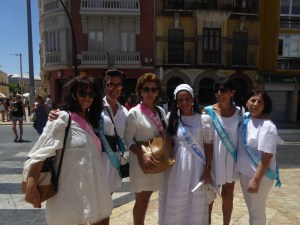
So many weddings on a Saturday afternoon and so many pre-wedding parties. All the boys wear the same T-shirts and the girls walk around in groups all wearing white. The boat parties sound hilarious from the beach.
A Bride to be
La Malagueta is the bullring which is under repair and closed. Apparently, the red cape doesn’t attract the bull. It is the large moving object that does it. Could be any colour. We were not intending to see a bullfight in case you are wondering.
At the beach there was a procession; little children ringing bells, brass bands, ladies in costume and lots of men wearing wetsuit pants carrying a statue. They put it down for a while, mingled around, had a couple of durries and then carried it into the church. It appears that this lucky lady who travels in from the sea on a flower adorned raft is, “the Virgen del Carmen” She looks after all the sailors, fishermen, scuba divers etc. all the way down the coast of Spain. Big job.
It’s been done before
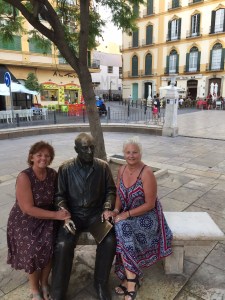
Pablo sitting in the park just in front of his house
Marrakech to Milan. 3.5 hours and $80 with Easyjet. Entry into Italy took over an hour because of the strict security regarding African visitors. However, when our turn came, we were waved through in the time it took to stamp the passport. No custom check either. Rented a car: oh dear – left hand drive, 130 on the Autostrad and Vodafone having internet issues. No maps! It is hard to find a paper map and even harder to get directions in English. After emulating the malteser advert and circumnavigating Milan 3 times, we finally were on our way to Nibbiaia in Livorno, Tuscany.
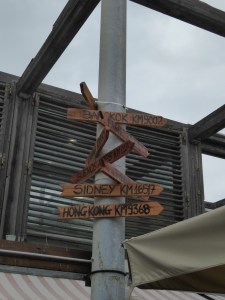
Who is Sidney and where are we?
Since arriving in Italy we have had exceptional kindness from locals. Our first accommodation was at a farmhouse in Nibbiaia. It is in The Livorno (means Leghorn?) district in Tuscany. As we spent so much time trying to get from Milan to this little dot of a place, we ended up being totally beaten by 2am. Asked a man sitting on a porch with his mother (why at 2am?) if they knew where our accommodation was. They didn’t. The next minute he was driving down the road beckoning us to follow as he had looked it up! Our hosts were also waiting up for us. This beautiful accommodation that was part of their farm house, was set up with real coffee, breakfast and a welcome cake. After buying provisions for the next few days and a GPS, we settled into the peaceful life. Washed all our filthy clothes and drank wine on the verandah in the late afternoon.
Nibbiaiai Accommodation
Casa in Nibbiaiai, Campagna
Tuscany
A Chianti winemaker lives here
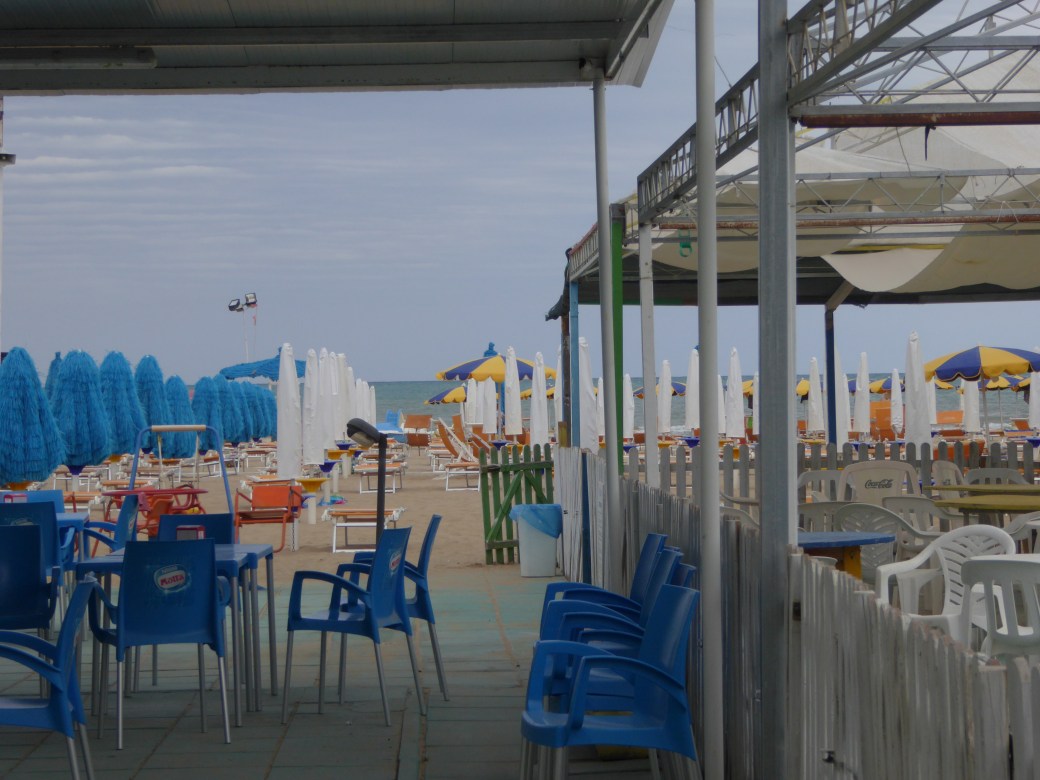
Quercianella is 5 minutes down the road from Nibbiaia and is on the Ligurian Sea. The beaches are rocks but the water is warm. There is a charge for umbrellas and sunbeds. To be under our budget we sat on the rocks. Everyone here wears coral shoes because it is so hard to get into the water without them.
Day at the beach
The Menu
The train from Livorno to Florence return is 18 Euros and they were clean, air-conditioned and had no graffitti.
Florence
The Galleria dell’ Accademia houses Michelangelo’s David and is around $A30 entry but was closed as it was Monday! We had both seen him before and guessed he hadn’t aged much in 30 years so it wasn’t too much of a disappointmet. The statue of Neptune in the Piazza della Signorria was almost covered in scaffolding – almost! Florence is lovely but the day we went it was around 39 degrees and very crowded.
An inappropriate use of scaffolding
Davids little brother
This trip was to discover all the small places that are off the beaten track but you can’t be so close to Florence without having one last look.
Love Italian gloves
Ponte Vecchio
View from the bridge
Siena – this is what Italy is all about. The landscape is lovely, lush and green and the colours and light are unique to Tuscany.
The Palio is a horse race in the centtre of town
Old image of horse race between communities
Siena is a beautiful old town but so is San Gimignano, a hill town in Tuscany, southwest of Florence. Encircled by 13th-century walls and with less people.
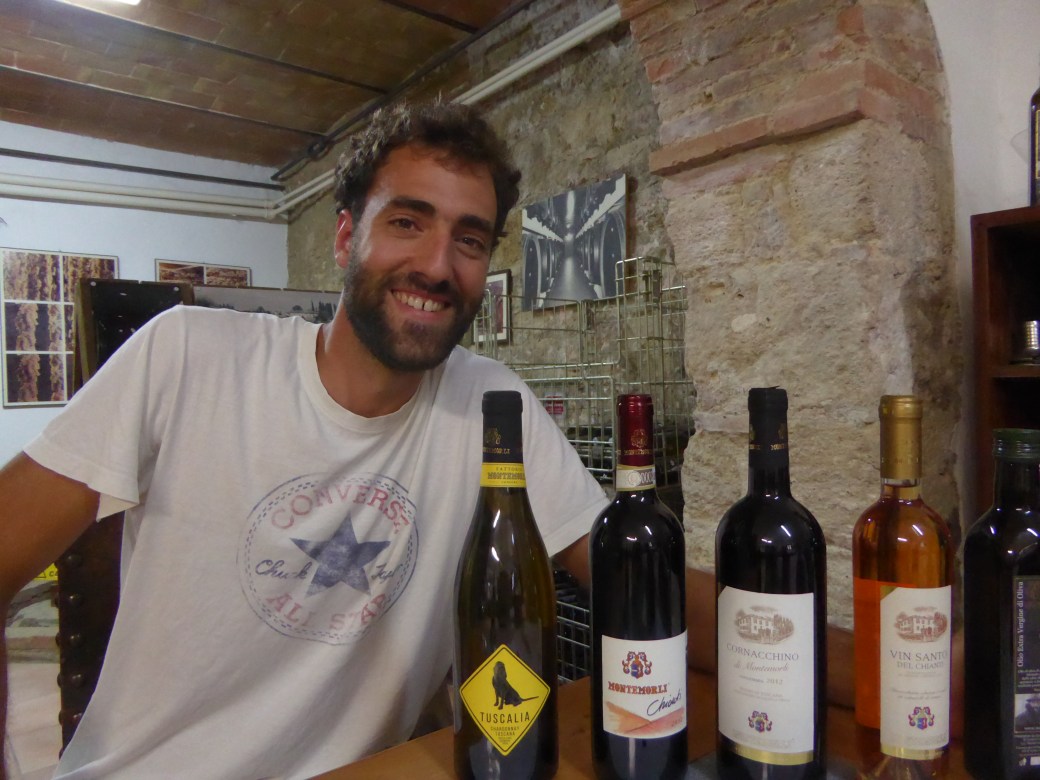
Montemorle is the home of our friend Vittorio’s, vineyard. His wines are lovely and there is a special story regarding his new label. A few years ago, he completed a vintage in the Yarra Valley, Victoria, Australia and loved the place so much that he called his new dog “Yarra” and the label looks like an Aussie road sign but with his dog on it.
Vittorio
Time to leave our hillside home in Tuscany and off to Umbria and to St Francis of Assisi’s home town.
The local restaurant and their washing
View from the local restaurant
Saint Francis was a lover of animals and is the Patron Saint of Ecology. Although born with a silver spoon and a total bad boy in his youth, he relinquished his wealth after having a dream. Francis reasoned, what could you do to a man who owns nothing? You can’t starve a fasting man, you can’t steal from someone who has no money, you can’t ruin someone who hates prestige. Very smart guy, very strange dream.
Assisi
Assisi is a wonderful place with so much history and character that it just leaves you with a peaceful, mellow feeling. Set on top of a hill, it looks over the farmlands below.
Another surprising example of Italian hospitality was in L’Aquila. We booked a B&B to find it was a block of flats. Sought confirmation of the address from a lady in the street and she took control of the situation and called the landlady while hand signalling parking directions. The landlady turned up 5 minutes later and we were ushered into a lift and the lady in the street (Luisa) came in as well only to find another two people in the kitchen. We had no idea what was going on. It was a common area with separately rented rooms. Before we even sighted our room we were told to “sit down and eat”. We still had no idea what was going on as our hosts were making us coffee, cutting up cake and chatting away in Italian while laughing and joking in sign language with us. It was great.
View from our room
Went to the restaurant across the road for dinner and the owner was just as friendly and the food was delicious. This is the reason we don’t stay in the big cities.
L’Aquila is in Abruzzo, the area that was decimated by the earthquakes in 2016 and there are still hundreds of cranes dotted inside the town doing repairs.
Note the cranes on the horizon
Taranto is a port and naval base in Puglia, Southern Italy.
We tend to underestimate the drive time between locations and this section was no exception. We also don’t have a plan when it comes to accommodation. We found a B@B above a bar/restaurant in Taranto – the old town in San Francesca Piazza. It was $25 each per night so sounded perfect and, it was lovely. We had to park our car outside the square as only motorbikes and tiny little tuk tuk type vehicles do deliveries. It is quiet in the daytime but the night becomes a social hub. Lovely room and very well maintained with modern amenities.
First stop on our walk to the landmarks of the city was the Castello Aragonese. We joined an Italian speaking tour of the military Castillo but couldn’t understand a word until a very dashing naval officer decided to give us a personal tour. It was fantastic. He was in charge of the Castillo and showed us more than the usual tourist route. We know what you are thinking but it was a delightful time with a delightful man. A highlight to our stay in Taranto.
The Castle
Watch out Jack, I have a gun
our handsome sailor
Another lost pilgrim
Toyota advert
beautifull aqua
who needs Copenhagen
The Beaches
The differences between Italy and Australia are: In Italy you can drink alcohol, smoke, take dogs, park anyway as long as you kind of fit, play soccer on the crowded beach (sand doesn’t fly up because there is none) and have live music and dance parties. Fun times. Downside is that a lot of beaches are privately owned. The public ones are full of fun, laughter and noise. Anything goes when it comes to swimwear and the body image that plagues us is not an issue here.
This is a pay as you sunbake beach complete with bar and music
Matera is famous for its ancient town, the “Sassi di Matera”. The Sassi originated in a prehistoric troglodyte settlement that was carved into the caves. These dwellings are thought to be among the first ever human settlements in Italy. They are now residences, restaurants and Bed and Breakfasts. Some people from here boast that their families have lived here for 9000 years. Not really something we would admit.
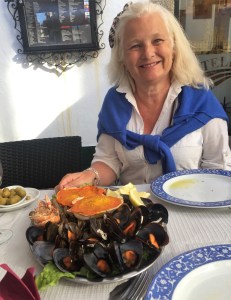
The last night in Taranto was a feast of Mussels as they are farmed here. We ordered an entrée size plate to share and were served a plate of at least 4 dozen mussels. Problem was no one could speak English to check if it was the correct order so we ate the huge delicious meal wondering if it was going to cost us a week’s budget. It cost 8 Euros. Wish we had known sooner so we would not have been so anxious eating them. Luckily it was early enough to cancel the main we had ordered. Seeing the look on our faces – they understood that!
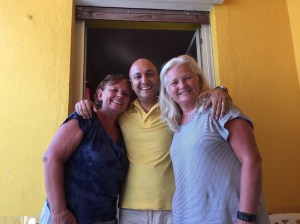
Salerno is in Campagna, the south of Italy. Came across the B&B Contessa with booking.com. Salerno is built into hills and our accommodation was very high up. Nerves of steel are required to drive up these extremely narrow one-way streets. It is a wonder how there are not thousands of accidents per day as they fly down these streets in mopeds and little cars without a care in the world. Yet again we were greeted by a charming host and ushered into the kitchen without a look at our room. Coffee and a lovely chat. Renting a room in Italy is a side event to turning up and having a chat. Pietro was our host and made sure we had maps, directions and all the advice he could think to tell us.
the harbour
Pietro – our host
View from our room
pizza in the park
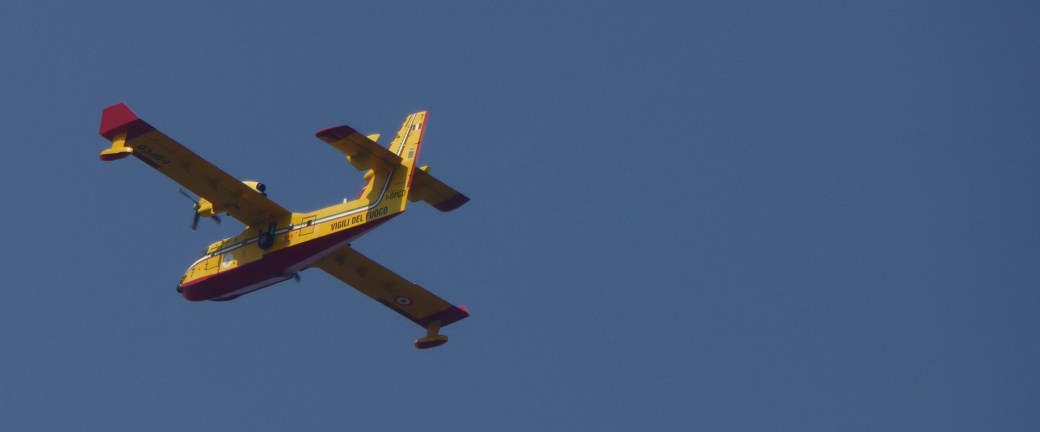
While he was talking to us at the kitchen table a huge noise came over the house. He casually said it was not a war but an aeroplane that collects water from the sea to take to the fires. They came over our accommodation every 10 minutes. We had heard that there were fires in Tuscany and Sicily. It has been an unseasonably hot year so far.
Noisy bugger
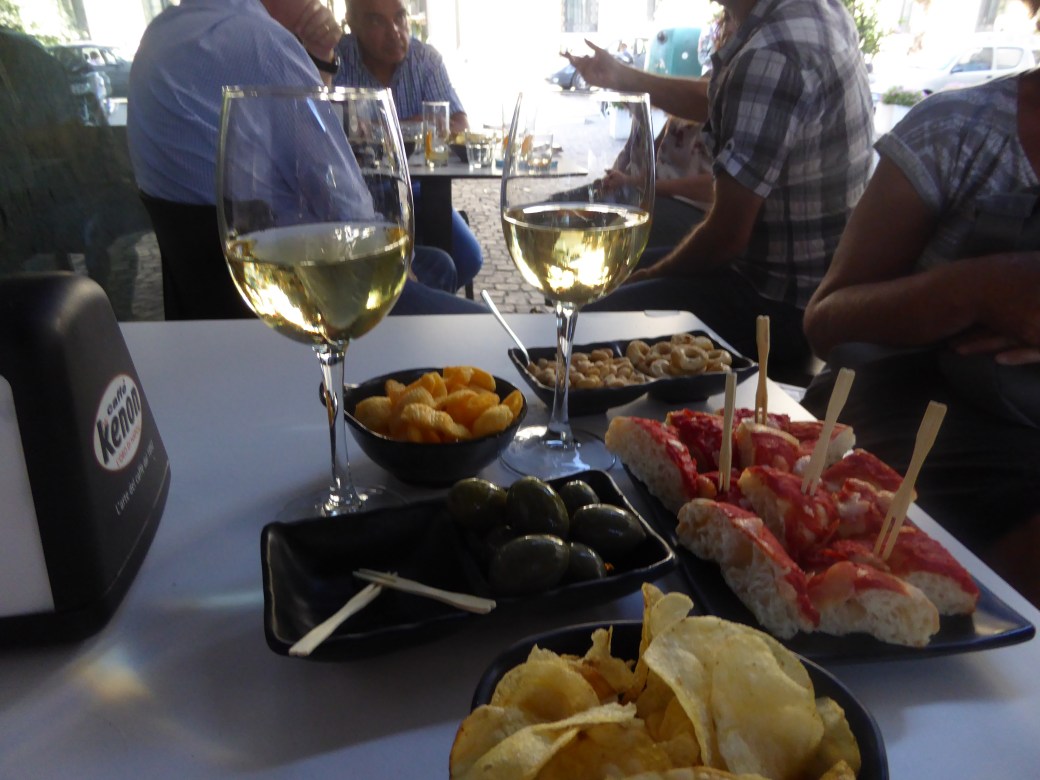
We have found, in Italy, to save money is to order a glass of wine each. With this purchase you receive peanuts, small pieces of pizza, olives, little biscuits and crisps. Dinner! All for the cost of 2 glasses of wine! 8 Euros.
Positano was a ferry ride from Salerno and cost 12 Euros. The view from the water is breathtaking and is what we remembered the Amalfi coast to be. The domed church sits front and centre of the town. Mauve wisteria shade the alleyways and purple Bouganvillia climb up over the houses. Positano is well known for its lemons. Limoncella, lemon candles, scents and the lemon shaped soaps that we were given as children as a treat in Australia. We loved them but they were always so ergonomically uncomfortable to use. There are tourist shops everywhere. The beach is so small and looks like bitumen from a distance. It is a very steep place and you see the sunburnt beachgoers trudging up the steep slopes to their accommodation. Beautiful though.
Bitumen beach
Wisteria Lane – desparate housewife?
Love these guys
view from the top
From the bus Positano to Amalfi
hairy chests
Amalfi hasn’t changed much but the prize for charm belongs to Positano.
Revenue raising
Further south to Cosenza and English becomes very rare. Booked a B&B and had our hosts greet us at 3. They stayed with us until about 7. We had wine and cheese and a great time. Excellent people. Viviana was from Sicilia and Antonio was from Codenza. Google translate had us all in stitches.
Antonio from Day & Night B&B in Cosenza
Sicily – The reason why it was kicked off the end of Italy’s foot.
With all the historic bad press Sicily has received in the past, it was difficult to not have a slightly teinted view but we took a positive aproach and hoped that we would be presently surprised. But no. From the toll collector blatantly trying to charge double on the autostrad to driving all the way south to Noto to find our accommodation was completely different to what was advertised. The twin room we booked with a view of the city, a pool and spa was a double bed, small window view of the delapidated building next door and no pool. The spa was a room next to ours with a massage table in it. Argued with the landlord via google translate which unlike yesterday, was no fun at all. Finally agreed to stay one night and be refunded for the 2nd. Oh well we have had a perfect run of great accomodation up to this point.
Ferry to Sicily
Sicily
In a panic to find accommodation for the next 2 nights we came across a B@B in Agrigento. We arrived early and went to a lovely beach where there was DJ and the music was great.
It was 37 degrees today and touched by the sun we arrived at the accommodation through a procession of drums and trumpets and over 50 young men carrying a statue of a black saint. We believe his name was Saint Calogero. When it stopped people hurled themselves on top of the raft he was sitting on and kissed and hugged it while wiping his face with cloth. He is supposed to have healing powers.
Later on there was another procession of drums.
Up two flights of stairs to a room that on one side,had a balconette with a view of the ancient square and, on the other side, a deck with sweeping views of the ocean. It was gorgeous and less expensive than the hovel from the night before.
The Scala dei Turchi or Stair of the Turks is close by Arigento and we ventured down to see an amazing site. The white steps are formed by marl, a sedementary rock. It looks and feels like plaster of Paris and is cool to touch even though it was 32 degrees.
The surrounding beaches are torqouise and sandy.
The Valley of the Temples in Agrigento is one of the most important archeological sites in the world. There are Greek ruins spotted all over the town even down to the beach. It looks like the sites are still being found. Tours in English are very rare and it was 34 degrees so we decided to forgo this one.
It was extremely hot here and our last day in Sicily was going to be 41 degrees. After a quick look around the town we got into our car and drove to Palermo.
400 shoes to encourage change on the Cathedral steps
beautiful balcony
wedding leftovers
our room
walls needing support
lots of work needed
Agrigento is the jewel in Sicily’s tarnished crown. Our impressions of Sicily may not be everyones but they are ours from the 3 days we were there.
The price of coffee is ridiculous!
Palermo. The port where we caught the ferry to Genoa!
It is called Genova when in Italy. The English pronounce this city Genoa but that is Genovas’ football team. Historically it was a club to represent England abroad.
What a beautiful town. It took 18 hours on the ferry but was worth not having to drive anymore! We had Pullman seats that were allocated in rooms. It had a pool, restaurants and bars but we took our dinner on board. It wasnt too bad sleeping on the ferry as it wasn’t full, you had the opportunity to lie down.
chaos in the carpark
They don’t take their shipping seriously
Genova from the ferry
Our accommodation was again, lovely and not very far from the historic area of Genova. Took a guided tour through the old areas where the wealthy traders and families once lived. Interestingly, only the very rich were allowed to cover their house in black and white stripes of marble and slate.
Also a lot of the old buildings have porticos and columns painted on them rather than the real architecture. It was a thing.
Santa Brigida is one of the last public wash troughs built in the 1600’s. The Basilica of San Siro is austere from the outside but quite Baroque on the inside. Bit of a shock really.
The main shopping street leads to The Bristol Hotel where the famous staircase is located.
After leaving the tour we went looking for a travel adaptor in a little shop in a little alley. We heard a loud commotion outside and asked the retailer if there was an argument going on. He said “no”. OK, Italians often sound like they are arguing. We left the little shop to walk smack bang into 2 policeman and one man of “African appearance” having a major issue; both parties throwing punches while trying to restrain the guy. We were about 3 feet away and the police had guns so we ran down a dark alley in case a shot was fired. The guy got away and the next minute there were at least 15 polizia and carabinieri blocking off the alley. Five minutes later one gentleman of “African appearance” feeling very sad for himself, gets shoved into a police car.
You are probably thinking ” why are they walking down alleyways?” Well the whole place is alleyways. It comes from rich families protecting their homes by being able to block of smaller streets from invaders or pirates. A few of the alleys closer to the port are multi cultural and the smell from the restaurants was enticing.
After a few more kilometres we had the most delicious mango Gelato and went back to pack for Barcelona tomorrow.
Places we would recomment to stay and prices per room, per night.
Casa in Campagna. A$60. Our beautiful spot in Nibbiaia, Tuscany
Aquarium B&B. A$80. A great host. L’Aquila, Abruzzi
B&B San Francesco. A $52. Above a cafe restaurant in Taranto, Pulia
B&B La Contessa. A$67. Another great host. Salerno, Campania
B&B Night and Day. A$60. More great hosts. Cosenzo, Calabria
Palazzo dei Giganti. A$ 67. Best spot in Sicily. Agrigento, Sicilia
Actor Hotel. A$120. Expensive for us but a delightful place .Genova, Liguria
First impression of Casablanca was how dusty it was and why would you buy a black car?
Hotel Azur in Ain Dieb faced the surf beach but the streets were almost empty all day because of Ramadan. The Muslim people fast between 4am and sunset so at 10pm the streets are crowded and there is music until 4am when they commence the fast again.
After walking 5 kilometres to a shopping mall that kept disappearing into the fog like a mirage, we were put through a security scanner and our bags were removed and x-rayed.
Two days later we moved to Casablanca city. The hotel Transatlantique was built in 1920 and the foyer is like an old black and white movie set. Very beautiful but the rest of the hotel was in very bad shape.
The old buildings that, at one point in their history would have been majestic, are in such sad disrepair. However, the Hassan II Mosque, completed in 1993, is imposing and cost around 800 million dollars. It was almost entirely funded by the public.
Friday is a special prayer day in Ramadan so we sat on a bench and watched hundreds of people pouring into the mosque. Looked like a grand final football crowd. The prayers are heard for quite a distance as they are blasted through loud speakers and reverberate of the stone walled buildings.
Rabat
Local train to Morocco’s capital. Rabat. Totally different to Casablanca. More trees, wide boulevards , the beautiful Kasbah des Oudaias and numerous other landmarks.
Meknes
After a 3 hour 1st class train (carriages just like in the movies, but no murder), arrived in Meknes, a famous wine making area of Morocco. This city was built by Sultan Moulay Ismail. He was a tad jealous of Louis IV of France and tried to outdo him by creating a Versailles type town with high walls and over 50 palaces.
The granary was used to store grains and other food stocks in case of war or famine. Luckily nothing occurred and the food was distributed. (it was also a stable for all his horses).
Taste an avocado and orange juice smoothie. They are delicious. No alcohol in Ramadan?
Volubilis
Try walking through an archaeological site in 42 degrees. But worse. Try being a Muslim guide unable to partake of food or water. Volubilis was a provincial Roman capital. and the area is filled with ancient mosaics and Storks!
Fes
Fes means pickaxe in Arabic. Why? Can’t remember.
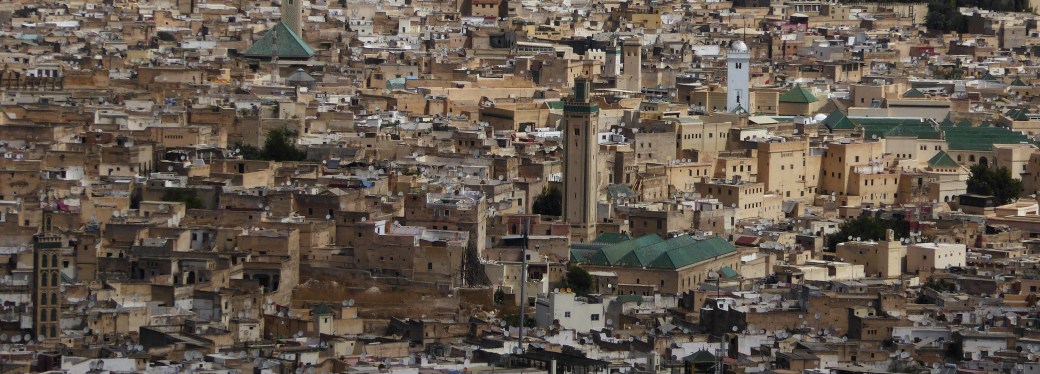
This city is just what you would expect. It was fantastic and does not disappoint. The medina of Fes is huge however from the hillside above, it looks empty. Hence, its name, “the mysterious city”.
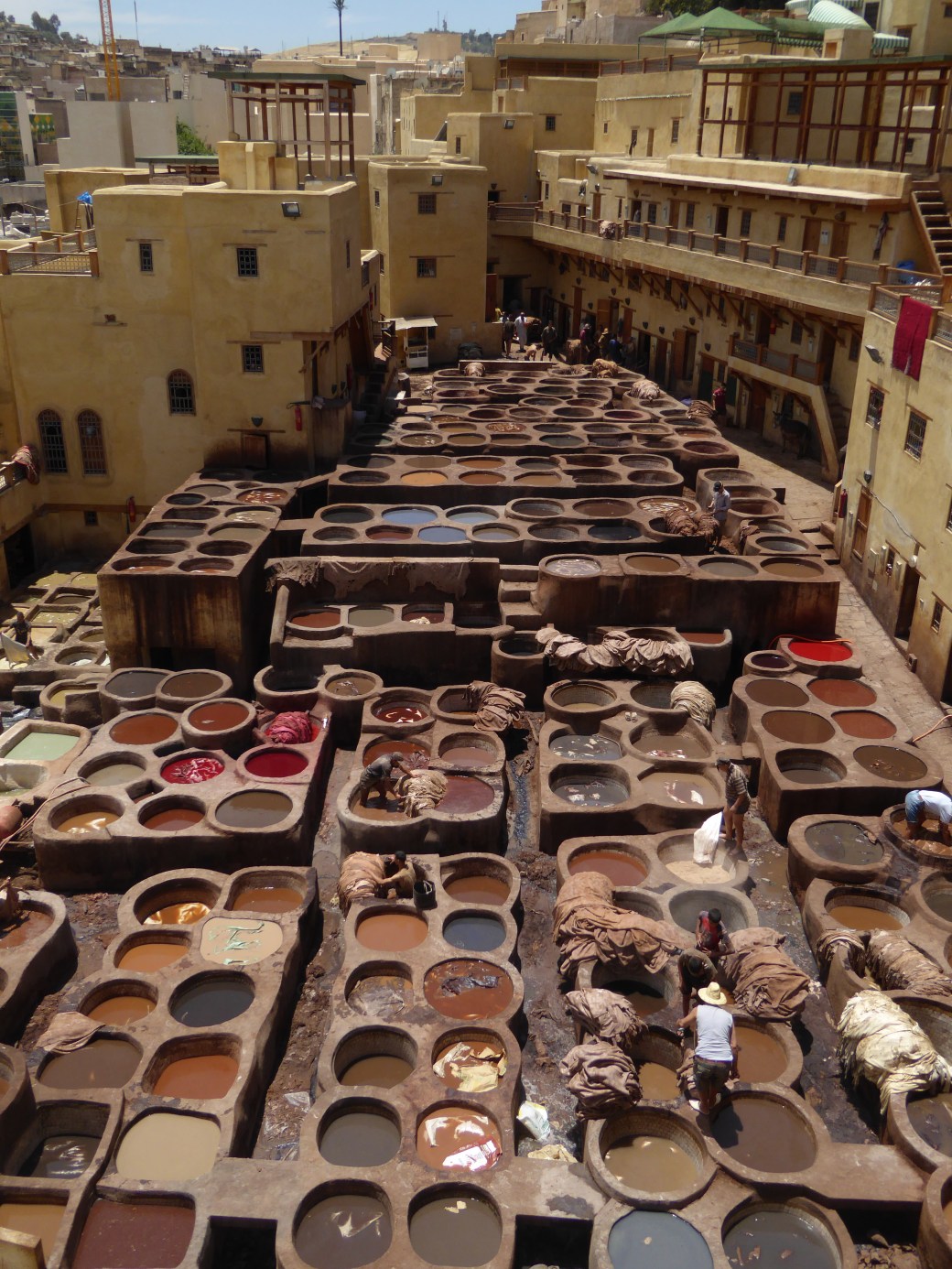
The Medina is a bustling, vibrant, exotic place consisting of 9400 alleyways. Each section or souk, selling its specialty. The tannery was a highlight with its dye pits.
Horses and mules are the only form of transport in the Medina and when you hear Balak! Balak! it means move over to the side or you will get run over by a mule. Trouble is the alleyways are very narrow and the mules are very wide.
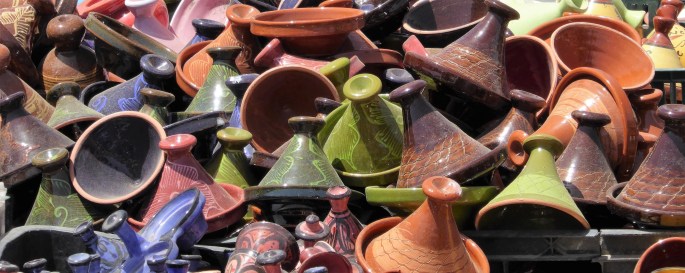
Morocco is known for its ceramics and most of the towns don’t have statues in the squares or parks. Instead, the buildings are decorated with the most intricately designed mosaics. So….naturally we visited a mosaic factory and watched the artisans draw the designs and cut up the square tiles into perfect shapes with only a chisel hammer.
Midelt
A long drive through cedar and pine forests. Stopped to say hello to some Barbary apes, North Africa’s only monkey and visited a beautiful Swiss like town called Ifrane that is a ski resort.
The accommodation here was a very pleasant surprise.
The Sahara
It is impossible to describe this experience. Driving through so many different landscapes: desert, vibrant green date palm plantations, cedar and pine forests and areas that are full of fossils and orchards. Incredibly diverse.
Seeing sand dunes in the Sahara for the first time was an awesome experience.
The pictures again tell the stories.
Travelled for an hour and a half by camel to our camp, 20 kilometres from the Algerian border. Slept under the stars choosing not to sleep in the tents.
The tents are made of woven goat hair. When it rains, the fibres mould together and become waterproof. Our meal prepared by the camel herders, was a Moroccan soup, chicken tagine and fresh fruit. It was delicious and afterwards the same guys played the drums and sang folk songs. Woke early to witness the sunrise over the desert and then back on the camel train. A magic time.
Todra Gorge
Travelled through the foothills of the Atlas mountains. Mud brick villages, lush pockets of date palms and family market gardens. The irrigation system here is hundreds of years old. Here again the accommodation was amazing and the scenery spectacular. No words!
Ait Benhaddou
This is an area where a lot of the desert movies have been filmed. Lawrence of Arabia, Black Hawk Down, Gladiator and Game of Thrones.
An incredible (use that word lot) place that now houses only a few families and uses tourism for its income. Our rooms peace was only interrupted by the donkeys going past and the call to prayer from the mosque.
Aroumd
This was a test. After all the bread, olives, tajines, lentil soups and skewers, we were informed that our accommodation was up a mountain and that the only way up was to walk or on a mule. Not wanting to look like Sister Sarah, we sauntered up the hillside to the top where the views were worth every step. It rained today for the first time and it was delicious.
Stayed in a Gite owned by a Berber family. Again our accommodation was wonderful only to be surpassed by the fantastic hospitality of our hosts.
The sun was shining on our downhill trek in the early morning and then a 5 hour drive to the West Coast.
Visited a Woman’s Co-operative that make the famous Moroccan Argan Oil.
Essaouira
A shoppers paradise. Lovely place with the bonus of being on the Atlantic Ocean where the sea breeze cools everything down.
It is hard to judge what places were the best because they were all so different and offered such diverse experiences. Must point out though that Essaouira is the most lenient for alcohol in Ramadan so how could you go past a Mojito or a few beers on the roof watching the sunset with new mates. Bliss.
The accommodation here was a Riad which is a mansion that could have historically been owned by a nobleman. It was a mezzanine type structure with a central courtyard. Our shower looked like a pizza oven.
Essaouira is a fishing town and the fish markets were great . So many sardines! Love sardines. It is surrounded by high walls and canons.
The art and handicrafts were a feast for the eyes and the people, although fasting in the heat all day, were beautiful, helpful and kind. Morocco’s population is mostly Muslim and the people here are certainly wonderful ambassadors of their faith. So polite and helpful. Dissipated any preconceived opinions we may have harboured.
The hamman. We had never heard of this form of bathing so we gave it a whirl. You strip down to your underwear and lie on a lino covered slab where the lady proceeds to throw very hot water all over you. Then she applies the olive soap all over your body and disappears for a few minutes where you lie there covered in slimy soap wondering if it is a joke and if she is coming back. Understandably this feeling was due to being taken there through narrow alleyways and up up up a skinny staircase. Anyway, she did return and attacked us with a really hard scrubber. Explanation of what came flying off our bodies is up to your imagination. Another dousing and a hair wash with Argan Oil. After that, an hour long massage and set on our way. Wow! What an experience. A very common weekly thing in Morocco. Cost $30. No pictures. Censored.
Marrakech.
Casablanca and Marrakech are a bit like the bookends to the many volumes of experiences that is Morocco.
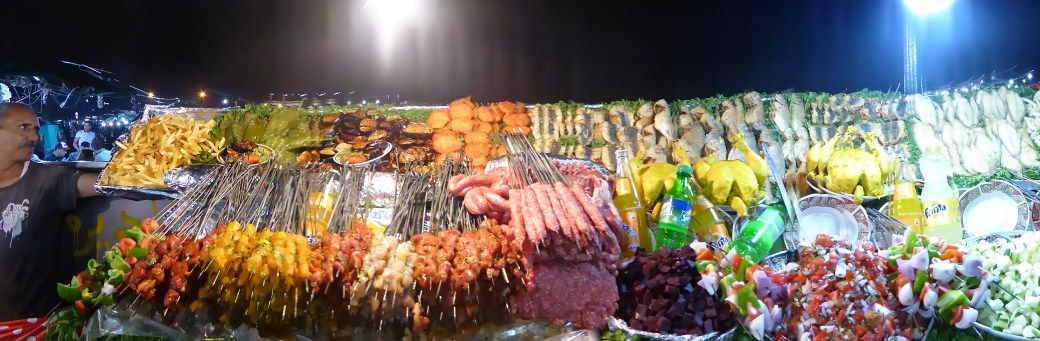
We arrived into the city to a very unpleasant 42 degrees. It is hard to appreciate the flavour of a place when you feel like you are gong to fall over from heat stoke. We had street food for dinner in the main square and it was delicious but there was no let up of people wanting you to buy watches, sunglasses or just plain beg for money. It is hard to appreciate the calamari with a watch shoved in your face. The markets were good but the merchants are more overt than we have seen. Having said that, it was Ramadan and as we were guzzling down the iced water to keep hydrated, the people were waiting until sunset before they could have their first drink of anything.
We had a final dinner with our tour mates who were a great mix of Australian, Kiwis. Canadians and a token Russian.
This trip was with Intrepid Travel and we don’t believe, in the time that we had, you could get a better deal. We saw and experienced so much and our guide Mohamed Ait Alla was fun, understanding and knowledgeable. All for less than $100 a day!
Santiago is a very complicated city to visit as there are not many street signs and the buildings all look the same. A bit like an Escher print. It is a lovely place but if you see a café you would like to visit but have things to do first, you can’t find it again.
Scallops and octopus are the Galicean dishes of choice. Unfortunately, because of the increase in pilgrim tourism, a cooked scallop will cost you 5 Euros but you can keep the shell as a souvenir because historically, when pilgrims finished their journey, to prove they had finished they picked up a scallop shell from the coast at Finisterre.
Today, the place to finish your Camino is in Santiago although history states that it was at Finisterre, meaning the end of the earth and so some hard core pilgrims continue on.
Took a day tour to Muxia pronounced Mooshia, the last place James the disciple visited. He was supposedly disappointed that his preaching was not widely accepted but the Virgin Mary visited him in a boat made of granite held aloft by angels and told him that he had done enough and could go back home to Jerusalem. However, when he returned home he was beheaded. Note: not going to confirm this tale as it makes a great read as it is. Moral is: don’t trust a woman in a granite boat.
Muxia is also the place where in 2002 an oil tanker broke in half and millions of gallons of oil began washing up onto the coast decimating the livelihood of the town for 2 years. Locals called it la marea negra, or the black tide.
Muxia is also well known for being the final scene of the movie “The way” which was part of the inspirations for attempting the Camino.
Finisterre means end of the world because, from this point, the Romans could only see ocean and believed that it was the end of the world. They also made sacrifices so that the sun would always rise and not fall into the ocean and disappear forever. The problem with taking a day tour is that they fill the day with some really lame stuff and you feel like a sheep. Went to a beautiful fishing village where we could eat at one of the many restaurants for a large tourist fee. We went to the supermarket and bought a baguette, some Spanish ham and cheese with a little bag of pitted olives. Cost 4 Euros. Drank Champagne and had our lunch at the beach. So much better.
This area boasts the biggest Horreo in Spain.
Delivered back to our hotel in the evening and on an overnight bus to Madrid by 10.30pm so that we could fly to Morocco tomorrow!
Travelling is an amazing experience. When you are on a bus and see a sign saying Costa Rica you realise the road you are on can take you there.
Whoever invented walking poles with anti-shock was a genius.
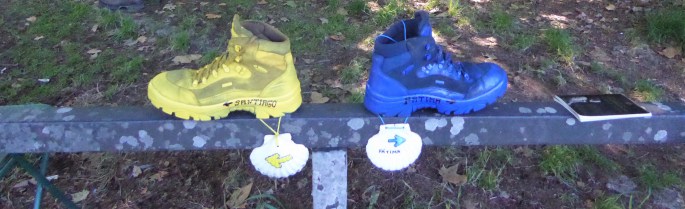
Flew into Viga and took 3 buses to get to Baiona, only to walk the 30 plus kilometres back to Viga the next day as the Camino rules state, to be a true pilgrim and receive your passport to heaven, you must walk over 100 kilometres.
Our room in Baiona
Baiona
Here we go Day 1
What had we signed up for? We had expected a casual stroll down country lanes but instead went up, up, up rather large hills and down, down, down steep slopes. Gravel, pavements, bitumen, dirt, rainforests, vineyards, desert. Oh the list goes on!
We dragged our weary bodies into Vigo at 7.30pm after ten and a half hours of hard slog. Found a lovely place to eat. Never too tired to find a yummy place to eat.
Thing is with the Camino, you have to look after your feet. Poor things get a workout.
In the Bidet
in the bath
In the sink
Vigo to Redondela
This was supposed to be a short day but no… 22 kilometres. 9am to 4.30. 22 kilometres sounds like nothing but the Camino route takes you off the main roads and around the winding paths through vineyards and small hamlets. It is a great way to see the countryside as long as your’e not looking at where you are placing your feet, as you often are.
Redondela is a beautiful town. It is like walking into a fairy-tale. There are squares leading into more squares and all have either churches, fountains, statues or cafes. The architecture is fantastic and the city has not ruined the façades with advertising.
Dinner by the river. The entrée was pine nut soup. Different. Looks like rizzoni pasta. Hate to find out the calorie count.
While walking, we noticed many small structures. They are called horreo and are found in the Galicia area. Mostly built in stone but some have wooden slats; very ornate and kept off the ground by pillars. They are used as a granary and are up high to keep rodents from the grain. Most houses have them.
Everything is closed from 2.30 -6.30 and the sun does not set until after 10pm.
You tend to meet the same people over the days. Lots of Germans, Dutch, French and Spanish. Haven’t seen another Australian yet and the Europeans are surprised we have come from so far away to do the walk.
Eucalyptus trees are everywhere but are apparently are a pest and not well accepted at all in the Galicean area.
Redondela to Pontevedra
24 kilometres and made it in 8 hours. A Camino record for us.
The rivers and creeks running through the towns and farmlands are pristine. There is no rubbish, you can drink the water and there are many ancient drinking fountains dotted along the way.
The Vineyards
The sense of humour
The Pilgrims
So Many water fountains
Grabbed some bananas and they tasted like banana custard. Tastes are exaggerated when you are tired and hungry.
Pontevedra to Padron
Record time! We are getting very good at this walking caper. Twenty two kilometers in 6 hours! Is that good?
Padron to Teo
Left our accommodation facing the Padron railway station at 9am and walked a mere 13.5 kilomeres to Teo as we decided to split our last day into 2 days. It was so worth it. Our accommodation is outstanding A beautiful 150 year old stone building with the best shower so far.
Teo to Santiago de Compostela
The city’s Cathedral was our destination and we finally finished the remaining 14 kilometres. As we trudged into the Praza do Obradoira with its Cathedral that houses the remains of St James, we were confronted with bloody scaffolding! The entire cathedral is covered in scaffolding! No Romanesque structure, no Gothic and Baroque elements. Instead, scaffolding and a sheet of material over the lot which is a pretend picture of what it looks like. There were pilgrims lying in the square looking up. Was it exhaustion or a massive “why now?”. Who knows.
Bloody scaffolding
Why?
The man of the moment
A Pigrims feet
When we lined up for our certificates and contemplated what we had gained and the reason for the journey, it would have to be that you are never too old to push yourself because if you don’t, you will never know that you can and what a waste that would be.
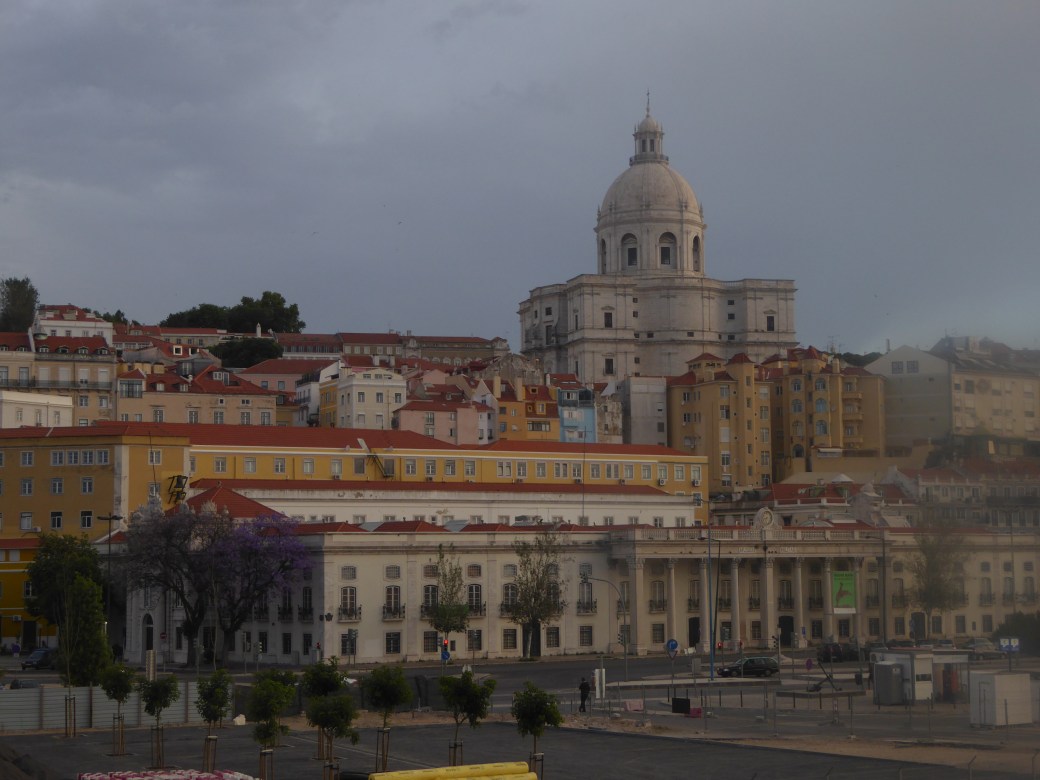
Absolutely gobsmacked at the historical beauty of Lisbon. Docking in port at 4.30am we were confronted with a beautifully lit domed building and as the sun came up, the full landscape of this historic town came into view.
It is hard to describe Lisbon but the feeling of warmth, history and respect for the old buildings is prominent.
There are no skyscrapers, the roads are small cobblestones and the pavements are patterned with stone. This is not a town to wear high heels.
Buildings have a façade of uniform tiles and the buildings are exquisite. Our hotel room is on the 4th floor (no lift) but it looks over the square and we have a Juliet balcony. Makes up for the hike up the stairs.
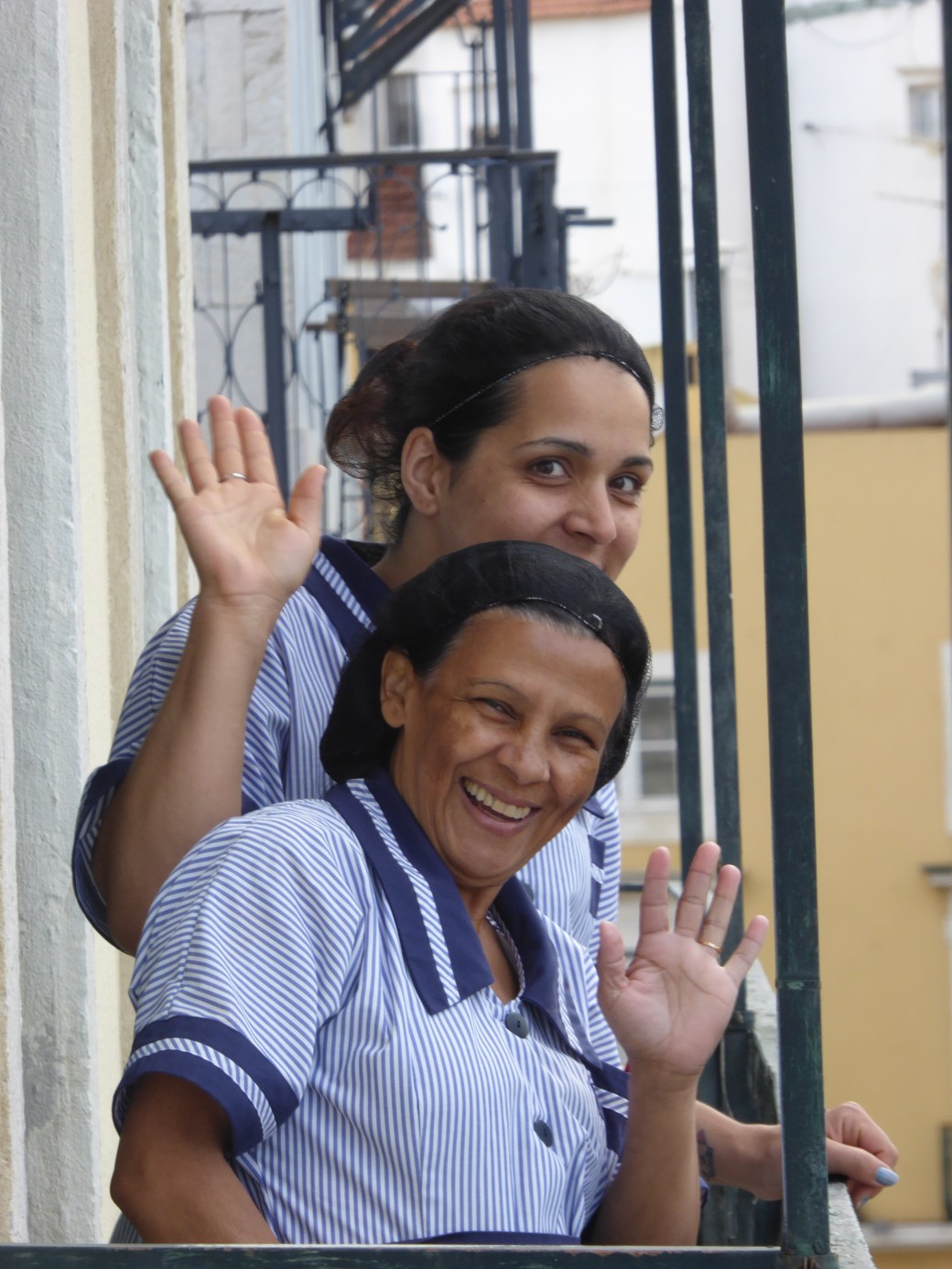
Our Hotel is the Pensao Praca Da Fiqueira, very welcoming and only $30 a night with breakfast and maid service.
The food is delicious. We have had Pasteis de Nata ( Cream Pastry) OR Custard tart from Pasteis de Belem which boasts the best tarts in Portugal. Saedinha de la Algave which were fried Sardines and pastéis de bacalhau – codfish croquettes from the Croqueteria dos Melhores in the Mercado da Ribeine. Sounds exotic.
Getting onto an old tram to a destination unknown was fun. We just got off when the majority did and found Porta de Sol and the beautiful Church that was built in the 12th century.
A bus to Belen where the palace. The queue to get in was wide as the building itself. Instead, we visited the maritime museum which was full of history from Magellan’s and Vasco De Gama’s time. Portugal was quite a powerful naval force in the 15th and 16th century. Brought back some of the stuff we learnt at school.
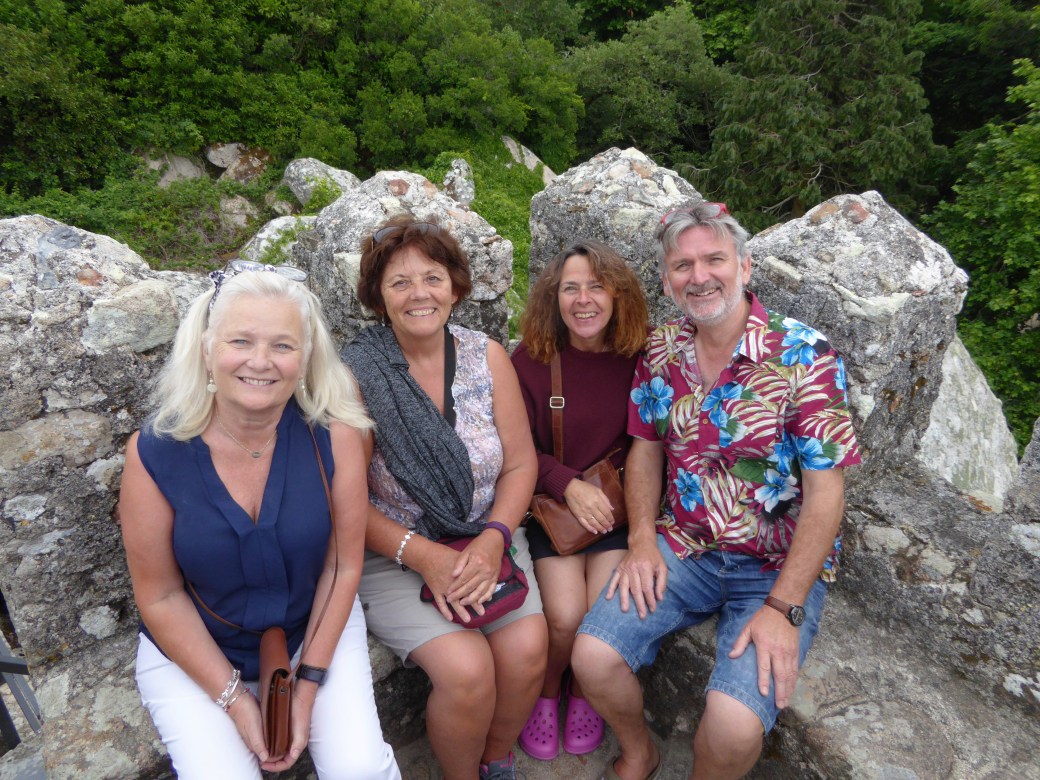
Drove to Sintra with our friends Nicole and Michael from the Isle of Lewis. Sintra is a resort town in the foothills of Portugal’s Sintra Mountains about from Lisbon. As it was a favourite of the royalty, it is absolutely packed with palaces and chalets.
We visited the Castelo dos Mouros and walked over the very “Chinese Great Wall” looking fortress.
Last day in Portugal. It is a great place. We will miss the swallows, the tiles, the cobblestones, the croquettes, the sardines and those delicious custard tarts!
Palamanturs Monarch is basically a Spanish speaking ship. Our travel agencies in Australia found it a bit too hard to book this trip so we booked it through Vacations to Go out of the U.S.
This is a repositioning cruise which means it is the last journey before it heads to Europe so the cost is substantially lower.
Although this ship was built in 1993, the food, accommodation and service is excellent. Only negative is that we dine with the same people every night. In our case, we are lucky to have two fantastic Isle of Lewis travellers but if they don’t turn up we are on our own. You can’t choose who you dine with in the restaurant and it’s a shit fight in the buffet.
Nicole and Michael run a B&B in The Isle of Lewis in the New Hebrides.
St Maartens
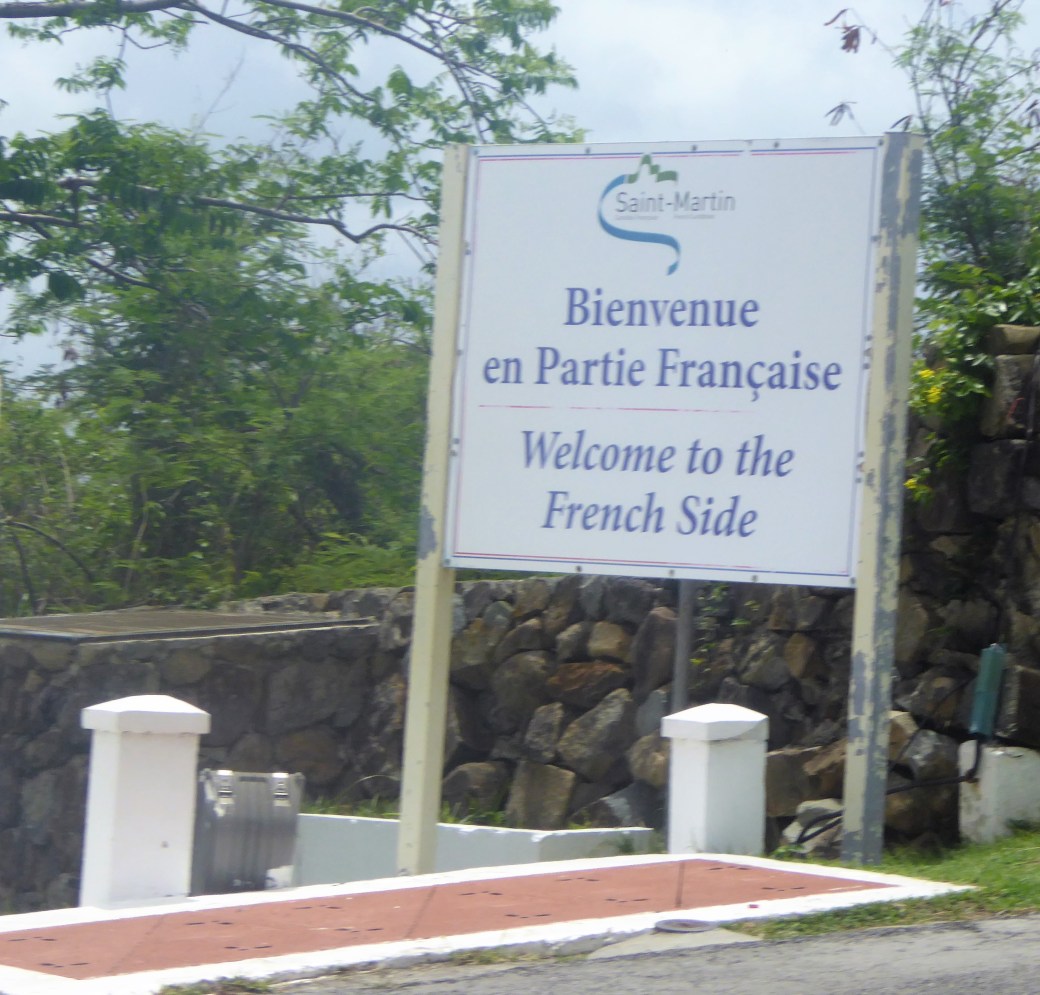
A beautiful Caribbean lsland that has the typical duty free shops lining the port. Every day is a promotion day especially as it was Mothers Day as well. Promotion” is the most used word on the island. Took a taxi with our 2 American friends around the island. It is divided into Dutch and French. The Dutch side is organised and the French side to quote our guide is “careless”. In other words, they don’t maintain their beautiful old historic buildings. The Dutch side had all the shops open but the French side was closed for the Sabbath.
Music is everywhere. The first few beats of anything have everyone singing or dancing. So much like we expected the Caribbean to be.
Maho Beach has the airport directly behind it and is famous for the planes landing so low overhead that you can almost see the passengers. In the past, when the jumbos could land, beachgoers had to hold onto the wire fence or anything else that was bolted down.
Drank a guavaberry Colada at Orient Beach where our very charismatic guide, Antony, warned us that it would make us giggle and feel a bit relaxed. He also told us that he was looking for a wife. Mmmm
Antigua
Moored at San Juan, the capital located in the north
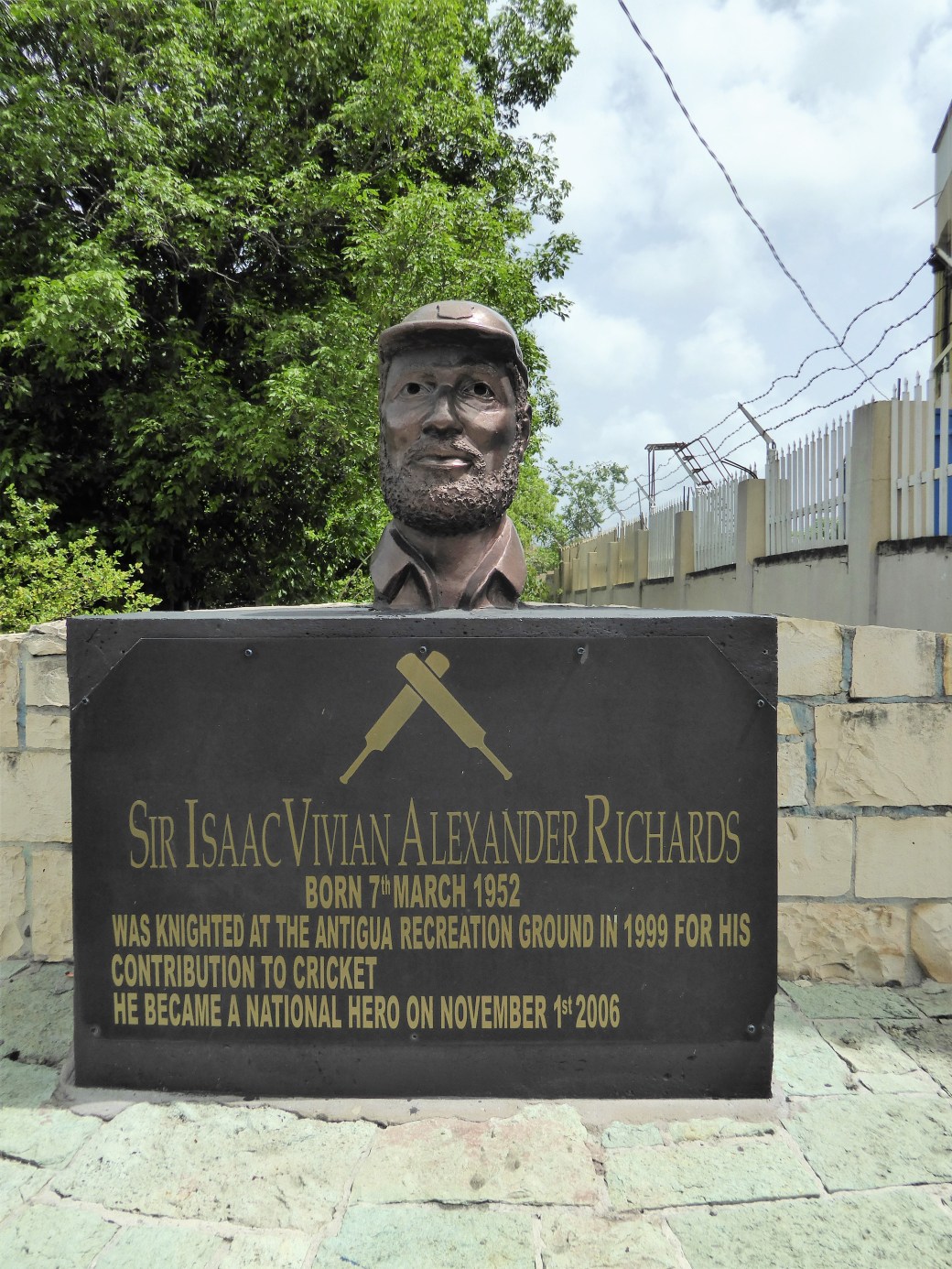
The birthplace and home of Sir Vivian Richards and Sir Anderson Roberts. National cricket heroes.
Our taxi driver lives in Switzerland and comes back to Antigua to maintain his father’s taxi business for the season. He is also a scout for potential Antiguan soccer players with contacts at Arsenal. We drove through the lush, tropical rainforest and saw a few of the many sugarcane mills spotted throughout the island. Slavery was a big deal and sugar cane was the chief export. Passed Freemans hill that was the first area given to the free slaves. Now the islands main income is tourism with quite a few famous names living on the island. Richard Branson, Robert de Nero and Sir Viv.
It is also famous for its black pineapple. The sweetest in the world.
A dip and a beer at Hawks Bill Beach. The water is so salty that you can stand upright and not have to tread water to stay that way. It is brilliant turquoise and the sand is bleach white. The Spanish do not give a toss about what they look like in a swimsuit!
On Sea
The cruise is 8 days straight sailing. That’s Ok. Time is spent walking, eating, swimming, drinking and sunbathing. The entertainment options during the day are a bit sparse unless you like making crepe flowers (one per person) or box making. The dance classes on deck are packed with absolutely no dress code. Everything is pretty loose, if you get my meaning. The Spanish keep to themselves because it is too difficult to make conversation with the English speakers and vice versa I guess. There are enough English options to stop going stir crazy though. We know of 4 Aussies on the ship. There are over 100 Digital nomads on the cruise as well. We have had two emergency drills and both times I think if it was a real emergency we would have drowned. We heard that the Captain was not happy at all with the drill today. It was a shemozzle!
Funchal, Madeira – The last stop before the mainland
Funchal means fennel meadow
Finally crossed the Atlantic Ocean! Eight days straight sailing is a bit tiring even though the weather has been superb and the food and wine was delicious.
Funchal is the Capital of the Island of Madeira. The landscape is covered with grapevines planted in the steep valleys (Madeiras most important crop) and banana plants. No land is wasted and it is such a picturesque place. All the houses have terracotta tiled rooftops.
Cabo Girao is the 2nd highest sea cliff in the world so its views of the coastline are incredible. There is a glass floor that takes you over the 589 metre drop.
he main market in the old town was a feast for the eyes. The fruit carts are works of art and it seems a pity to ruin the display. The best varieties of passionfruit we have ever tasted.
There is a pretty ugly looking black fish that lives deep in the Atlantic. It comes a few hundred metres at night to fed and that is when the fishermen catch it.
Ugly looking critters
The island of Madeira is very beautiful. The coast is dotted with the remainder of a massive stone wall. The cobblestone streets are charming and there is a beautiful 500 year old Gothic church standing in the old town. All the building materials would have been brought over by ship from Portugal.
There is a cable car that travels to the top of the island but it gets quite foggy up there.
Cork products are everywhere and range from rings and bracelets to handbags, hats and backpacks.
Last Day at Sea
A farewell to our friends and some to be continued…..
First stop Bogota. Our hotel was in the Business district. Not a tourist area. One hour taxi ride took us to Zipaquirain, a beautiful town just outside Bogota and the Catedral de Sal, an underground Catholic church built within the tunnels of a salt mine, 200 metres underground. Still used for mass and weddings. The acoustics are excellent.
nice looking church for a small town
The salt mine exterior
This was not what we expected. The Cathedral was carved by the miners and is a working salt mine.
Architects and engineers won the opportunity to produce the plans.
The small town was beautiful with a large square.
Zipaquirain Square Bogota Colombia
Our dinner was an empanada bought of the street for 75 cents. Scrumptious and filling.
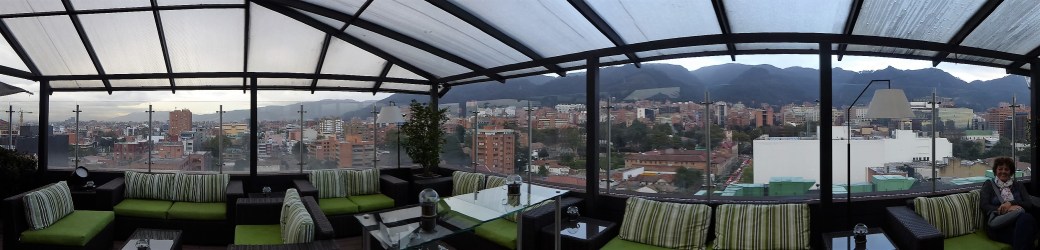
Lashed out and had Vino Tinto in the 12th floor bar.
Room with a view
On the lookout for a Panama hat. Apparently they have always been made in Equador and it was Teddy Roosevelt who coined their name because he saw them in Panama. Such confusion.
Came across a speakeasy type bar called the Blind Tiger and drank the most beautiful Colombian Club Red beer. The store front was a false bookcase. Very cool.
The Blind Tiger Bar
speakeasy
Best beer ever
The altitude is still quite high in Bogota – 2650 metres above sea level which is 400 metres higher than Mount Kosciusko.
There are so many little bars facing the street with 3 or 4 chairs. The “men only” past time is the soccer. Every bar and restaurant has a television or two with the soccer on.
Most noticeably are the straight queues for the buses. No crowding, just orderly lines. It looks like Colombia is in a better financial situation than Peru. There are less traffic jams ad better roads.
Medellin
4 nights
Uber is available in Colombia but is still illegal. A passenger is required to sit in the front seat to avoid detection by the traffic police.
Our accommodation was a shock but you get what you pay for. We hiked our bags up the 2 flights of stairs to come across a woman sitting behind bars. The room consisted of 2 bedrooms, a kitchenette and a bathroom. Bet you are thinking – that is OK. So were we until it rained and the kitchenette flooded. The flat had no windows, no chairs or table, a dodgy hot water system and a front door that didn’t reach the top of the frame. There was a bar underneath so we went to sleep listening to a group of drunk Colombians singing until 2am. It was great. The landlady took all our filthy Amazonian washing and washed it for nothing.
The cost for this was $200 for 4 nights. Entertainment was free.
Luckily we could enjoy Nicks (Val’s son) spacious apartment in Laureles. He has been living in Medellin as a digital nomad. His rooftop deck was quite enjoyable.
Val, Nick & Louise
Val, Pete and Nick
View from the deck
Interesting roof tiles
Comuna 13 was a very dangerous place in the era of the Cartels as it was controlled by the urban gangs. It is extremely steep and the houses look like they could all come crashing down with the slightest earth tremor. The people are friendly and it is very safe now.
Steep accomodation
bricks keeping the roof on
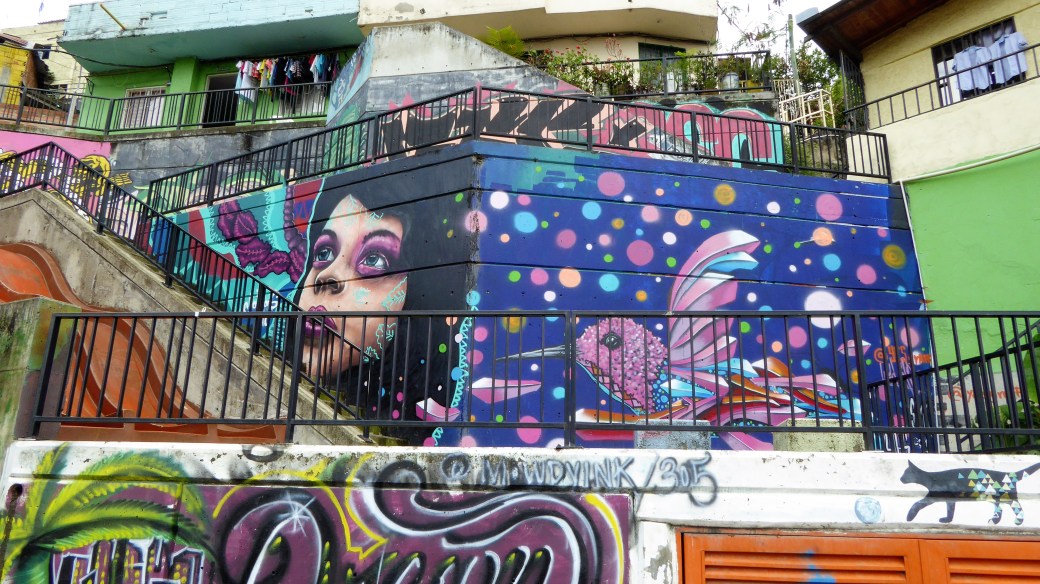
The Graffiti all over the community depicts the struggles of the people and now encourages the kids onto a different path. The Government installed covered escalators to encourage and make it easier for the residents of this community to go to work.
Escalators
More escalators
An example of the fantastic street art
Walked 8 kilometres in the morning from Lleras Park in Poblado. The roads are closed on Sunday mornings and there are hundreds of people walking, running and cycling along a 5km route. We just walked with them then back to where we started. Quite a hike.
Church in the Park
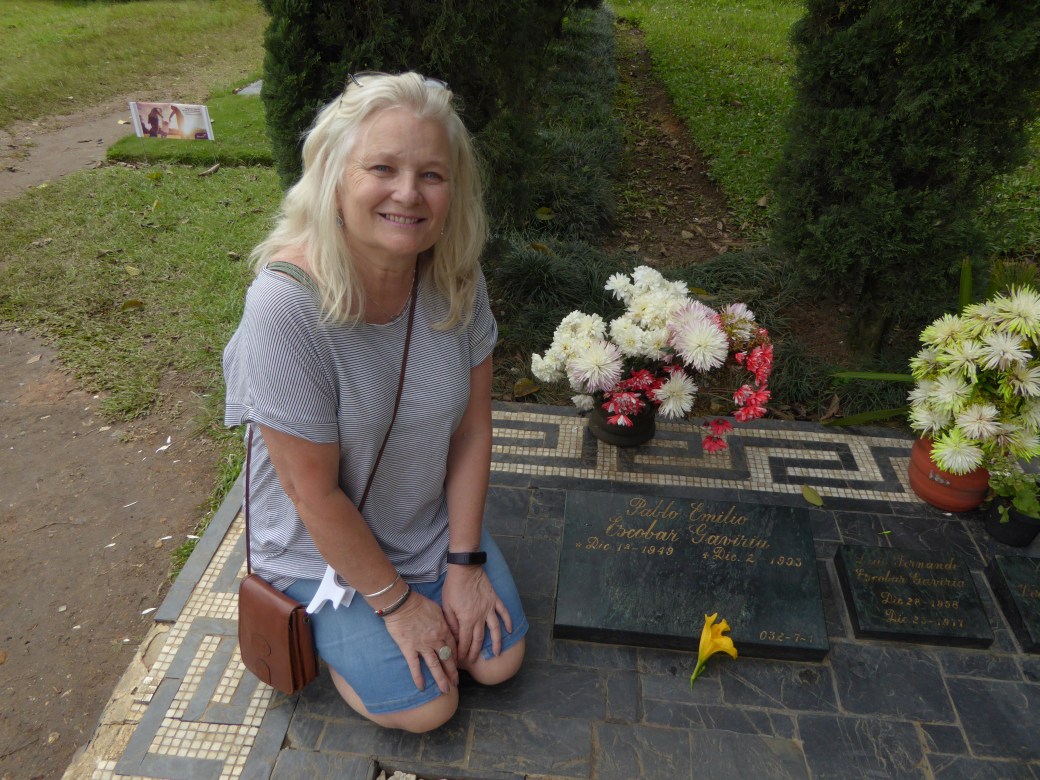
Pablo Escobar was an infamous resident of Medellin. The people of this city are in two camps. He was a crook, we know that – but also a fierce campaigner for the poor people building houses and football fields for communities in the poorest areas of Medellin. These people then became his lookouts.
The Pablo story has become famous through NARCOS but the story has a few major enhanced discrepancies. It has however, increased the tourism to this city.
Our final day in Medellin was a coffee tour. These can be all day trips but a friend of a friend organised a trip to a closer coffee plantation.
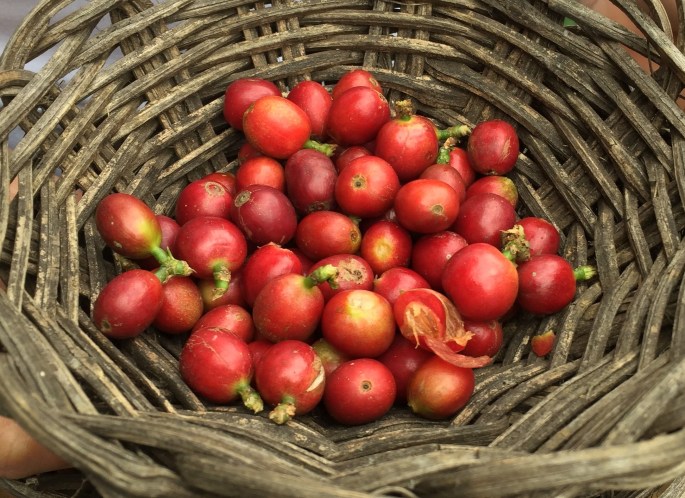
We walked up the steep muddy paths to pick the berries then put them through the depulper, washed them and watched the inferior coffee beans float to the top. We learnt about the three different grades and were shocked at what inferior beans go into instant coffee. No more instant for us.
After all the bug spray we doused ourselves in while in the Amazon, we forgot to do it before the coffee plantation. We look like we have the measles!
Cartagena
Pronounced Cartahayna
2 nights
What a difference the temperature is from Medillin and it was only a 1 hour flight north. We are 10 degrees north of the equator. Hot, hot, hot.
We are on the 16th floor of a highrise that overlooks the Caribbean Sea.
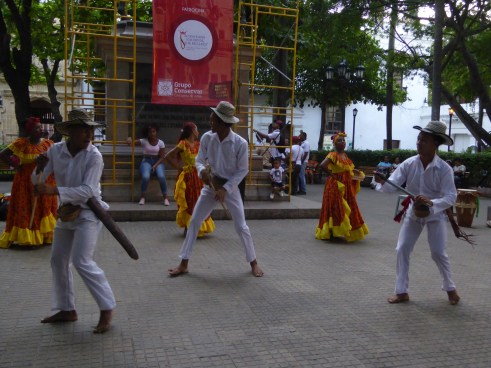
Everyone dances here. As soon as music is heard everyone starts doing the Salsa. Incredible and so happy and friendly but so bloody hot!
The old town is fascinating. It is a walled area where cannons are placed at close intervals both north and south facing the sea and the bay. This was to stop the French and English plundering the Spanish ships that were plundering Peru and taking their treasure back to Spain.
Cartagena was an importer of slaves and the main square was the auction room. It is a fascinating place. In the old days, the wealthy people would lock the poor people and their slaves out at sunset.
The front doors of the older houses have two front doors. One for the slave to enter and one for the master on his horse. The Spanish would not enter the same door as their slave. The door knockers denoted the status or profession of the owner.
the small door was the slaves entry
The owner was a sailor
Colombia is famous for coffee, chocolate, cloth and you know what else. It also makes delicious sweet treats and has the most curvaceous women we have ever seen.
By the way, leaving the purchase of the hat until Equador which will be a different trip. Too many fakes and one cannot have a fake Panama hat!
Bon Voyage as we are leaving for out Trans-Atlantic voyage to Lisbon. Off the air for 15 days.













































 Drove to Sintra with our friends Nicole and Michael from the Isle of Lewis. Sintra is a resort town in the foothills of Portugal’s Sintra Mountains about from Lisbon. As it was a favourite of the royalty, it is absolutely packed with palaces and chalets.
















 Two Travelling Bags